
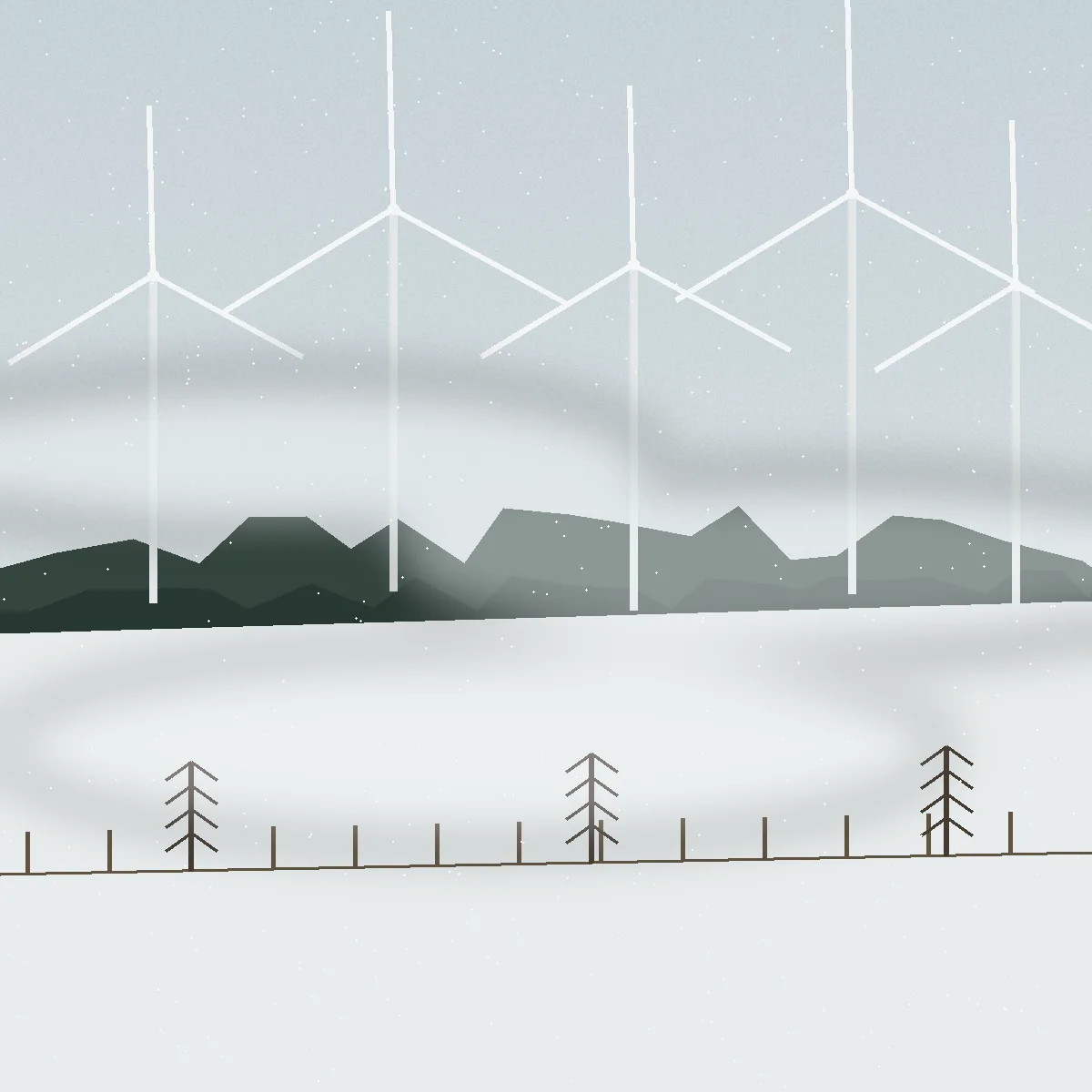
In the northwest corner of Lewis County, where the ground climbs out of the Black River valley onto the Tug Hill Plateau, winter does not so much arrive as take up residence. Lake-effect snow rolls in off Lake Ontario from October into April, and the drifts on the plateau can run on the order of two hundred inches in a hard year. Since June 2006, that weather has been working for the grid. Standing across the ridgelines here are 195 wind turbines, the Maple Ridge Wind Farm, which at completion was among the largest wind farms in the eastern United States and which can still produce a maximum of roughly 322 megawatts, enough by developer accounting for on the order of 150,000 average homes.
I.A cold, steady place
Tug Hill is a raised block of plain about twenty miles inland from the lakeshore, high enough to catch the full force of west and northwest winds that slide across Ontario and pick up moisture over the lake. The same exposure that makes farming here patient work, thin soils and short seasons, makes it some of the best wind country in the state. That combination, hard agricultural ground and excellent wind, is the quiet logic of upstate renewable development: the land that grows the least grain often spins the most steel.
The farm was developed in the mid-2000s by Horizon Wind Energy and PPM Energy and entered service in June 2006, a two-phase build that put 195 turbines across the towns of Martinsburg, Harrisburg, and Lowville. Ownership has changed hands over the years, as wind assets do; today the farm is held by Avangrid Renewables and EDP Renewables North America, two of the largest operators in the region.
II.Why the cold helps
Counterintuitive as it sounds, a wind farm earns its keep in January. Cold air is denser than warm air, so a twenty-mile-per-hour breeze arriving off a frozen lake carries more kinetic energy than the same breeze arriving off a summer field. Turbines are rated against standard conditions, and Tug Hill spends much of the winter well below them. The result, as operator materials and regional reporting have described for years, is that the plateau's least comfortable months are its most productive ones.
Wind here also pairs naturally with the rest of the upstate mix. Niagara's hydro plants run steady through the cold months, and winter demand in New York peaks on dark January evenings. The lake wind tends to build on the same fronts that drive those peaks, which is one reason grid planners have long valued northern wind even before storage was cheap.
III.Keeping the machines honest in January
The counterweight to all that dense air is ice. Rime and freezing rain can load a blade unevenly, and an iced rotor is both less efficient and harder on its drivetrain, so modern cold-climate machines carry ice-detection systems and are programmed to feather their blades and shut down rather than push through. Operator accounts of the North Country fleet describe exactly that routine: monitor, shut down, restart when the blade is clean. It costs the farm some of the very output the cold air promised, but it protects the machines that have to keep working for thirty years.
The service roads are their own winter project. Two hundred inches of snow has to be plowed before a crane or a parts truck can reach a nacelle, and the farms here maintain those roads year round, which is one of the quieter ways a wind project serves the towns it sits in.
IV.Who owns the ridge
Maple Ridge's land is not owned by the power companies. It is leased, row by row and ridge by ridge, from the farm families of the plateau, and a turbine pad typically takes only a small fraction of the acreage it leases, so hay and grazing continue around the towers. Project materials and local reporting have long described lease and tax payments flowing to host landowners, towns, and school districts, which in a county of this size is not a rounding error. Twenty years in, the visual argument about the towers has mostly been had; the economic one, on the ridge, was settled quietly in the farms' favor.
V.What twenty years prove
A wind farm that has run through twenty North Country winters is, in this young industry, close to an elder statesman. Maple Ridge entered service before the iPhone, before New York had a climate law, and before anyone spelled gigawatt in a governor's press release. The state's 2019 climate law, the Climate Leadership and Community Protection Act, now sets a goal of 70 percent renewable electricity by 2030, and the projects being permitted to meet it are larger than anything on Tug Hill: the Alle-Catt wind project in the Southern Tier, permitted at 340 megawatts, was described by the state siting board as set to be the state's largest wind farm.
The plateau does not mind. Newer machines stand twice as tall on half the count, and the fleet above Lowville will eventually be repowered, blades and drivetrains swapped for whatever the 2030s standard becomes. What will not change is the geography. The wind still comes off the lake all winter, the snow still stacks against the fence lines, and the catalog entry for this ridge will keep filing itself, one cold front at a time.